The short version
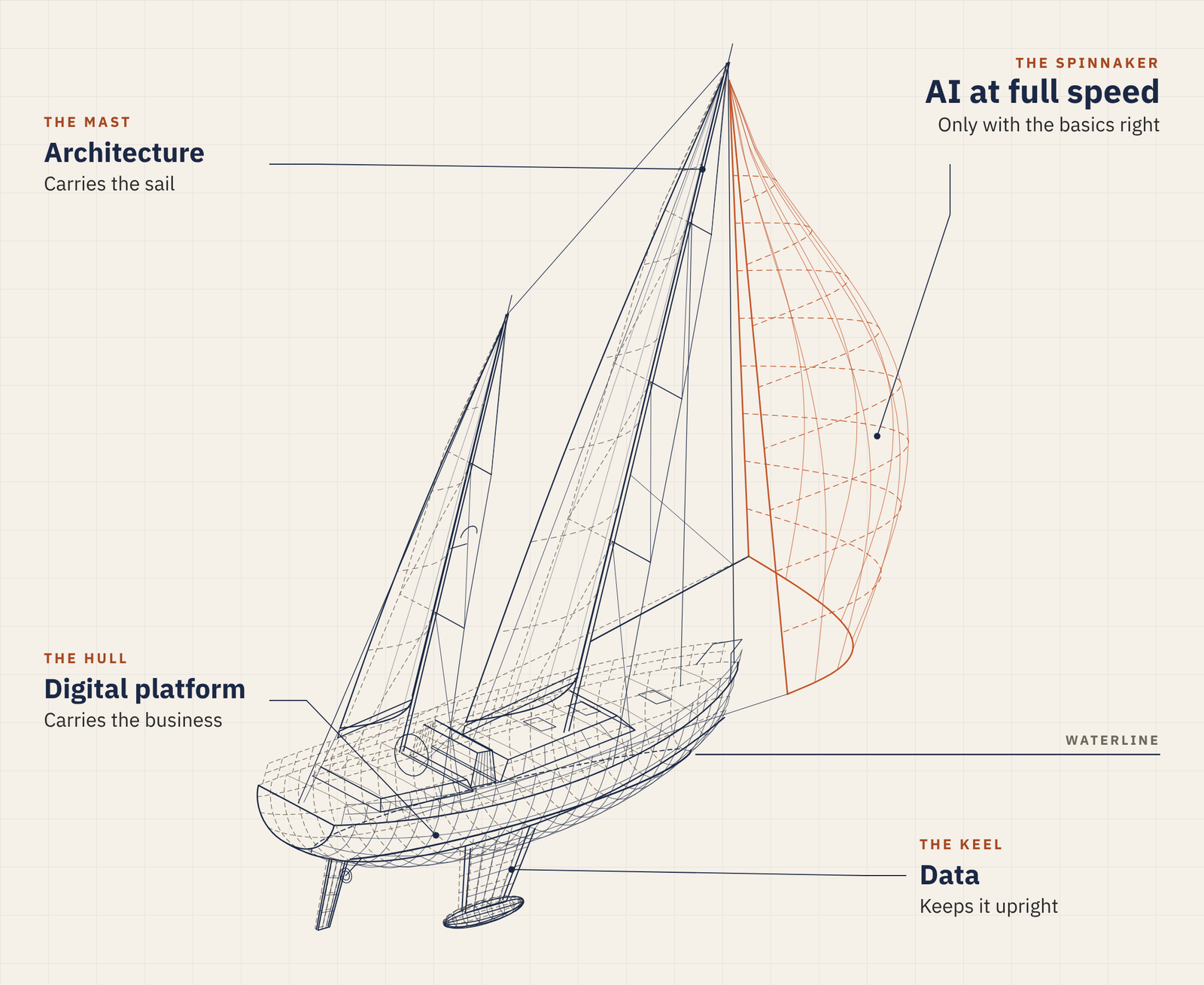
AI fails in insurance for a plain reason: it is switched on above platforms, data and operating models that were never fit for it.
Insurance has always needed a sound digital platform, good data and clear architecture to get the most from its people. Firms that lacked them still traded, because skilled people filled the gaps. A language model fills gaps too, by making things up. It needs the same foundations people always deserved, and it needs them without exception.
So an AI strategy that does not start with the foundations is a plan for expensive pilots. The firms that will gain most from AI are the ones that fix the basics first, and fix them in the order the value chain demands.
What AI needs that people never did
An experienced underwriter can price a risk from a broker's email, two spreadsheets and a policy system that disagrees with both. They know which number to trust, who to ring and what the wording really means. That knowledge has carried the market for decades.
It has also hidden the cost of weak foundations. Rekeying, reconciliation and local spreadsheets are paid for in time and judgement, not on a line in the budget.
AI removes the hiding place. When an underwriter meets a gap, they fill it with judgement, and they know they are doing it. When a language model meets a gap, it fills it too, with whatever sounds plausible. That is a hallucination: an answer that is made up, and delivered with the same confidence as a fact.
Without solid architecture and data, you leave your AI open to making it up. It is acceptable for an underwriter to fill a gap. It should never be left to a language model.
So when your AI gives an answer, where did it come from? Your policy record, your wordings and your underwriting guidelines? Or three conflicting copies of the same policy, and a guess? And could you show which, if a client or a regulator asked?
The four foundations
Four things have to be true before AI pays back at scale. None of them is new, and each is harder than buying a model.
| Foundation | What it means | What AI needs from it |
|---|---|---|
| Digital platform | Core systems that run the value chain end to end, with work passing between stages without rekeying | Somewhere to act: AI can only automate a step that exists in a system |
| Data | Captured once, defined once, owned by someone, and trusted by underwriting, claims, finance and the regulator | One version of the facts to reason from |
| Architecture | A design that lets platforms, data and AI be added, changed and replaced without starting again | Clean ways in and out, so a model can be swapped as the technology moves |
| Operating model | Teams organised around the work, with the skills and ways of working to keep improving it | People who trust the output, know its limits and change how they work |
The fourth is the one most often left out. A firm can fund the first three and still see no return, because nobody changed how the work is done.
What this looks like across the value chain
The same AI use fails or succeeds depending on what sits beneath it.
| Stage | AI use | On weak foundations | On sound foundations |
|---|---|---|---|
| Underwriting | Submission triage and data extraction | Extracted data is rekeyed into the policy system, so the time saved is lost again | Extracted data lands in the risk record, and the underwriter starts from a complete view |
| Underwriting | Pricing and exposure support | The model sees part of the book, so accumulations are understated | Pricing and exposure draw on the same live portfolio |
| Broking | Placement and market selection | Recommendations rest on incomplete placing history | Every quote and decline is held as data, so advice improves with each placement |
| Broking | IBA matching and reconciliation | Automation stalls on inconsistent references and manual fixes | Cash is matched at source, and exceptions are few and visible |
| Claims | Notification, triage and reserving support | Coverage cannot be checked reliably against the policy | Policy, coverage and claim are linked, so triage is safe to automate |
| Finance | Close and reporting | AI summarises numbers that do not yet reconcile | Ledgers reconcile at source, and AI explains the movement |
In every row the model is the same. The difference is the platform, the data and the people around it.
What this looks like in practice
One insurer we have seen invested in an AI tool that structures the data in submission emails. It works, and it is live. But the data it produces does not flow on down the value stream and into the related processes, so the insurer has not had the full benefit of AI across the value chain.
The AI was not the limit. What lay beneath it was.
This is not a multi-year wait
None of this means stopping for years to rebuild while competitors move ahead. The foundations are built iteratively, one value stream at a time, and each step delivers something people use.
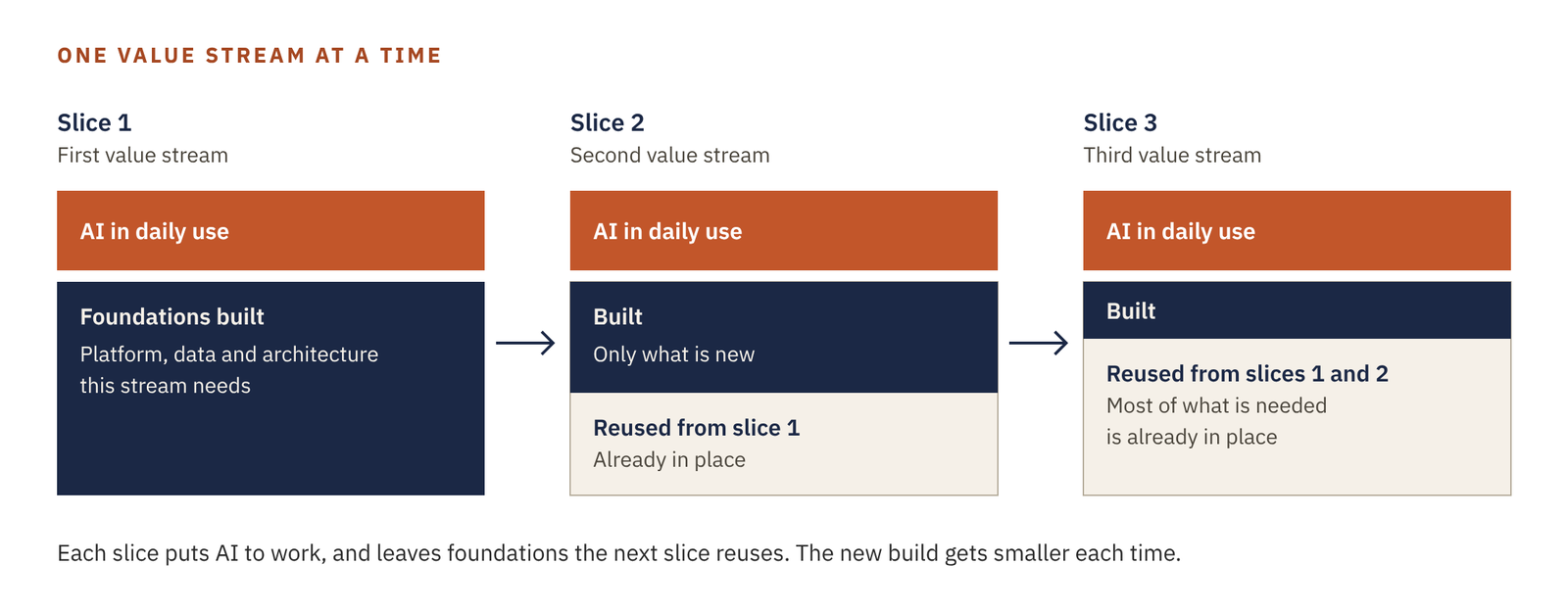
- Build in thin slices. Take one value stream. Build only the platform, data and architecture that stream needs, and put AI to work in it. Then take the next. Each slice leaves foundations the next one reuses.
- Use what the cloud already provides. The major cloud platforms offer data, integration and AI services as ready building blocks. You assemble them in your own environment. You do not build from scratch, and you do not wait for a large programme to finish.
- Keep your intellectual property. Your data, your underwriting knowledge and your way of thinking are the asset. Hold them in your own cloud environment, and treat the AI model as a part you can replace.
That last point deserves care. A niche AI vendor can look like the fast route. But if your knowledge and your logic sit inside its product, you are improving a tool your competitors can also buy. Specialist tools have their place for a narrow task. The test is simple: when the contract ends, what do you keep?
Where to start
Start with ambition, then let the value chain set the order of work.
- Set the ambition. Decide what the business needs to become, and where AI changes its economics. Strategy comes before any technology choice.
- Map the value streams that matter. Follow the work from start to finish, and find where it waits, is done twice or is corrected by hand.
- Assess the foundations honestly. For each stream, test the platform, the data, the architecture and the operating model. Few firms are strong in all four.
- Fix foundations and use AI together. Pick one stream, fix what it needs and put AI to work in it. Early, real use funds and guides the rest.
- Build the operating model as you go. The team that delivers the first stream becomes the pattern for running and improving every platform after it.
This is not an argument for waiting. It is an argument for sequencing: foundations and AI advance together, one value stream at a time.
Questions for the board
- How are you assuring your employees, your board and your regulators that your AI is working from your enterprise knowledge, and following your way of thinking?
- When your AI meets a gap in the data, does it say so, or does it make something up? How would you know?
- Which of your value streams could run end to end without rekeying today?
- For your ten most important data items, who owns each one, and do underwriting, claims and finance agree on its definition?
- If a better AI model appears next year, how long would it take you to adopt it?
- Who is accountable for changing how work is done, and not only for delivering the technology?
- Which of your AI pilots is in daily use by the people it was built for?
How Bind helps
We help firms set the ambition, test the foundations and deliver the change.
- Ambition and strategy: a technology, data and AI strategy that a board can approve and a team can deliver.
- AI readiness and adoption: where AI will pay back across your value chain, and what has to be true first.
- Implementation partner: we build the team and deliver the first value stream with you.